
Intelligence Foundations
The Principles, Methods, and Processes That Define Intelligence
Intelligence is the disciplined process of transforming information into knowledge that supports informed decision-making. Far beyond the popular image of espionage, intelligence is a structured analytical function practiced by governments, military organizations, law enforcement agencies, international institutions, and private-sector organizations. Its primary purpose is to reduce uncertainty by collecting relevant information, evaluating its reliability, analyzing its meaning, and delivering actionable assessments to decision-makers.
In an increasingly interconnected world, intelligence has become an essential capability across multiple domains. National security agencies rely on intelligence to identify emerging threats and protect state interests. Businesses employ competitive intelligence to understand markets and anticipate competitors’ strategies. Cybersecurity professionals use threat intelligence to detect malicious activities before they escalate into major incidents. Humanitarian organizations gather situational intelligence to coordinate disaster response and allocate resources effectively. Although these applications differ in scope and objectives, they all share the same fundamental principles and methodological framework.
Understanding Intelligence
At its core, intelligence is not simply the collection of information. Vast quantities of data exist in every environment, but data alone possess little value unless they are organized, interpreted, and transformed into meaningful insights.
A useful distinction can be made between four related concepts:
- Data consist of raw facts without context. Examples include isolated numbers, satellite images, intercepted communications, financial transactions, or individual social media posts.
- Information emerges when data are organized and placed into context. A list of cargo shipments or a timeline of financial transfers represents information because it begins to reveal patterns.
- Knowledge is produced through systematic analysis, where information is interpreted, connected, and understood.
- Intelligence is knowledge specifically developed to support decision-making. It combines analysis with judgment, assesses uncertainty, and provides recommendations or forecasts regarding future developments.
For example, a satellite image showing several cargo ships entering a commercial port represents data. Identifying the vessels, their origin, cargo manifests, and shipping routes transforms those observations into information. Comparing this activity with historical trade patterns and regional political developments generates knowledge. Concluding that the unusual concentration of strategic materials indicates preparations for large-scale industrial expansion constitutes intelligence because it informs strategic decisions.

The Purpose of Intelligence
The central objective of intelligence is to reduce uncertainty. Decision-makers rarely possess complete information when confronting complex situations. Intelligence narrows the range of uncertainty by identifying relevant facts, evaluating competing explanations, and estimating probable future developments.
Rather than providing certainty, intelligence supports informed judgment. Analysts recognize that complex environments are dynamic and that new evidence may alter previous assessments. Consequently, professional intelligence products express conclusions in terms of confidence and probability rather than absolute certainty.
Effective intelligence seeks to answer several fundamental questions:
- What is happening?
- Why is it happening?
- Who are the principal actors?
- What capabilities do they possess?
- What are their intentions?
- What is most likely to happen next?
- What alternative scenarios should decision-makers consider?
Fundamental Principles of Intelligence
Professional intelligence is founded upon several universally recognized principles that ensure analytical integrity and operational effectiveness.
Accuracy
Accuracy requires that information be verified through multiple independent sources whenever possible. Analysts distinguish carefully between confirmed facts, assumptions, and speculation.
For instance, reports suggesting that a foreign company intends to acquire critical infrastructure should not be accepted solely because of media rumors. Financial records, regulatory filings, corporate statements, and commercial databases should be examined before reaching analytical conclusions.
Objectivity
Objectivity demands that analysis remain independent from personal opinions, political preferences, or organizational expectations. Intelligence professionals evaluate evidence regardless of whether it supports preconceived assumptions.
Analysts must resist confirmation bias—the natural tendency to seek information that validates existing beliefs while overlooking contradictory evidence.
Timeliness
An accurate assessment delivered after critical decisions have already been made has little operational value. Intelligence must therefore reach decision-makers while it can still influence outcomes.
During a cyberattack, for example, identifying malicious activity within minutes enables network administrators to isolate compromised systems before significant damage occurs. The same information delivered several days later is largely historical.
Relevance
Intelligence should address specific decision-making requirements. Collecting large quantities of unrelated information consumes resources without improving understanding.
If a company seeks to evaluate supply-chain vulnerabilities, intelligence concerning transportation infrastructure, geopolitical tensions, and raw material availability is highly relevant. Celebrity news or unrelated economic indicators are not.
Integrity
Analytical integrity requires transparency regarding sources, confidence levels, assumptions, and limitations. Decision-makers should understand not only what analysts believe, but also why they reached those conclusions and how confident they are in their assessments.
Confidentiality
Many intelligence products contain sensitive information that could compromise operations or endanger individuals if disclosed improperly. Appropriate classification systems, access controls, encryption, and the principle of “need to know” protect sensitive information while ensuring that authorized personnel can access what they require.
The Intelligence Cycle
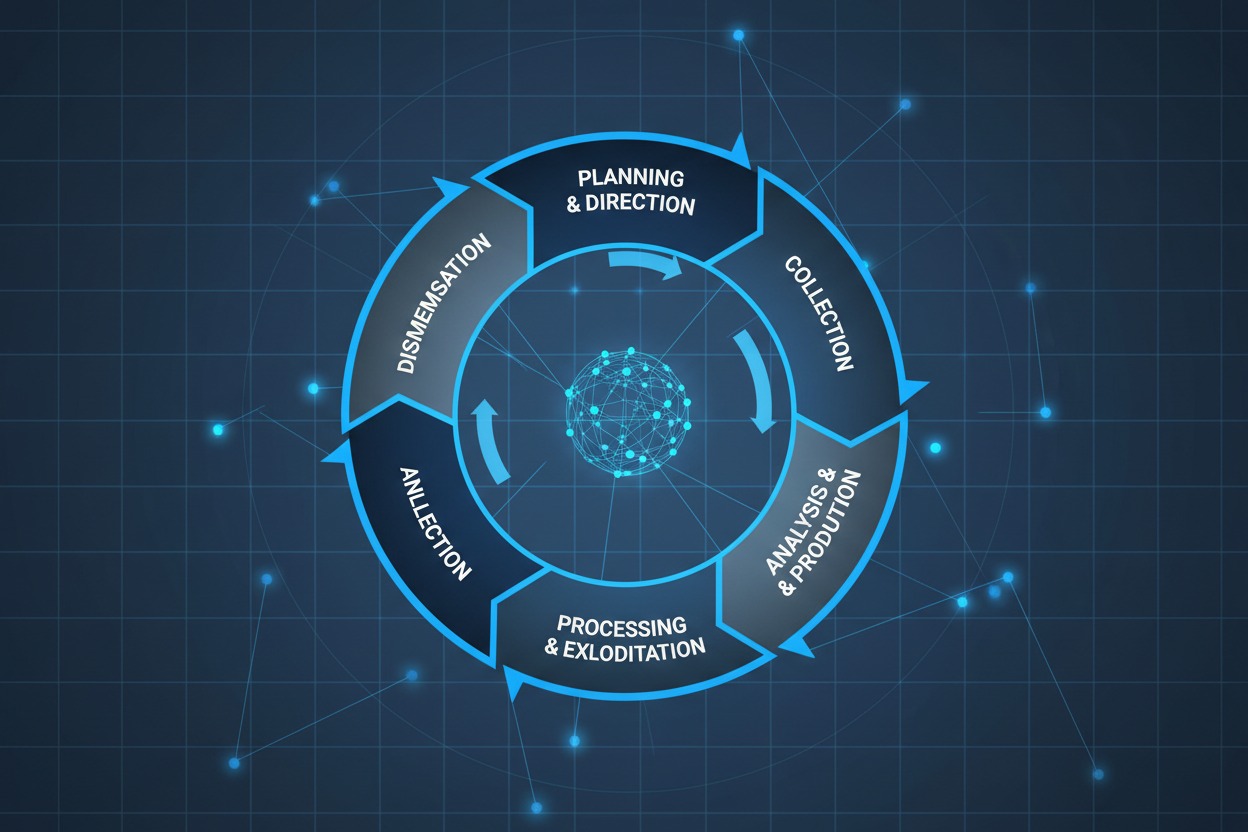
The intelligence cycle provides the systematic framework through which information becomes actionable intelligence. Although often presented as a sequence of distinct stages, the process is continuous and iterative, with each phase informing the next.
Planning and Direction
The cycle begins by defining intelligence requirements. Decision-makers identify the questions that intelligence must answer and establish priorities according to strategic objectives.
A government may ask whether regional instability threatens national interests. A corporation may seek to determine whether a competitor intends to enter a new market. A cybersecurity team may require early warning of emerging ransomware campaigns.
Clearly defined intelligence requirements ensure that collection efforts remain focused and efficient.
Collection
Information is gathered from multiple sources using a variety of intelligence disciplines.
Open Source Intelligence (OSINT) collects publicly available information from news media, academic publications, government reports, corporate filings, social media platforms, commercial databases, and geospatial imagery.
Human Intelligence (HUMINT) relies on information obtained from human sources, including interviews, confidential informants, diplomatic reporting, and field observations.
Signals Intelligence (SIGINT) involves the collection and analysis of electronic communications and signal emissions, including radio transmissions, telecommunications, and certain digital communications where legally authorized.
Geospatial Intelligence (GEOINT) integrates satellite imagery, aerial photography, mapping data, terrain analysis, and geographic information systems to understand spatial relationships and physical environments.
Imagery Intelligence (IMINT) focuses specifically on interpreting visual imagery to identify objects, activities, infrastructure, and environmental changes.
Measurement and Signature Intelligence (MASINT) analyzes distinctive physical characteristics such as electromagnetic emissions, acoustic signatures, chemical traces, thermal patterns, or radiological indicators to detect activities that may not be visible through conventional observation.
Modern intelligence operations frequently combine several disciplines simultaneously, allowing analysts to corroborate information and reduce uncertainty.
Processing and Exploitation
Collected information is often incomplete, fragmented, multilingual, or technically complex. Before meaningful analysis can begin, raw data must be processed.
Processing may include translation, transcription, image enhancement, metadata extraction, data normalization, removal of duplicate records, and integration into searchable databases. Increasingly, artificial intelligence and machine learning assist analysts by identifying patterns within massive datasets while leaving analytical judgment to human professionals.
Analysis and Production
Analysis is the intellectual core of intelligence. During this stage, analysts synthesize information from diverse sources, evaluate reliability, identify patterns, test competing hypotheses, and construct evidence-based assessments.
Professional analysis extends beyond describing current events. It seeks to explain underlying causes, evaluate intentions and capabilities, anticipate future developments, and estimate the probability of alternative outcomes.
Analytical techniques may include trend analysis, scenario development, link analysis, network mapping, risk assessment, hypothesis testing, geospatial modeling, and structured analytic techniques designed to reduce cognitive bias.
For example, an analyst observing increased recruitment, expanded manufacturing capacity, patent registrations, and procurement of specialized components may conclude that a technology company is preparing to launch an innovative product within the next year.
Dissemination
Intelligence has value only when communicated effectively. Finished intelligence products are tailored to the needs of their intended audience and may take the form of written reports, executive summaries, operational briefings, dashboards, threat alerts, or strategic assessments.
Effective dissemination emphasizes clarity, concise language, appropriate visualization, and explicit communication of uncertainty.
Feedback and Review
Decision-makers evaluate the usefulness of intelligence products and provide feedback that refines future collection priorities and analytical methods. This continuous feedback loop ensures that intelligence remains aligned with evolving operational requirements.

Intelligence Assessment
The final product of the intelligence process is the assessment. An assessment represents the analyst’s reasoned judgment based on available evidence, not a statement of absolute fact.
Professional assessments distinguish between observed facts, analytical interpretation, and forecasted developments. They also communicate confidence levels, acknowledging uncertainty where evidence is incomplete or contradictory.
Typical estimative language includes expressions such as:
- Highly unlikely
- Unlikely
- Possible
- Likely
- Highly likely
This standardized language helps decision-makers understand the degree of confidence associated with each judgment.
Critical Thinking and Cognitive Bias
Human cognition is susceptible to systematic errors that can distort analysis. Professional intelligence organizations therefore emphasize structured analytical methods designed to minimize bias.
Common cognitive biases include:
- Confirmation Bias, the tendency to favor information that supports existing beliefs.
- Anchoring Bias, where initial information disproportionately influences subsequent judgments.
- Availability Bias, which overestimates events that are recent or particularly memorable.
- Mirror Imaging, assuming that other actors think and behave according to one’s own cultural or institutional perspective.
- Groupthink, where pressure for consensus suppresses alternative interpretations.
Structured analytic techniques, peer review, red-team analysis, and alternative hypothesis testing are widely employed to challenge assumptions and improve analytical rigor.
Practical Example: Monitoring Industrial Expansion
Consider an intelligence team tasked with assessing whether a multinational manufacturing company intends to establish a new production facility in Southeast Asia.
Analysts begin by defining the intelligence requirement and identifying relevant indicators. Open sources reveal new land acquisitions, construction permits, executive recruitment, and environmental impact assessments. Commercial satellite imagery confirms significant construction activity. Shipping records indicate increasing deliveries of industrial equipment, while financial disclosures show substantial capital expenditure in the region.
Each individual observation is insufficient to support a definitive conclusion. However, when integrated through systematic analysis, these indicators form a coherent pattern. The resulting assessment concludes that the company is highly likely to inaugurate a major manufacturing facility within the next twelve months, significantly increasing regional production capacity.
This example illustrates the fundamental purpose of intelligence: transforming diverse fragments of information into coherent knowledge that enables timely and informed decisions.
Conclusion
Intelligence is a disciplined process grounded in rigorous methodology, critical thinking, and analytical integrity. Its value lies not in collecting vast amounts of information, but in transforming evidence into reliable knowledge that reduces uncertainty and supports strategic, operational, and tactical decisions.
As global challenges become increasingly interconnected—spanning geopolitical competition, cybersecurity, economic resilience, organized crime, environmental risks, and technological disruption—the importance of sound intelligence continues to grow. Whether practiced within national security institutions, multinational corporations, humanitarian organizations, or research communities, the foundational principles of intelligence remain constant: collect responsibly, analyze objectively, assess critically, communicate clearly, and continuously adapt to an evolving world.